
Windows
v1.7.6A focused workspace for your Windows desktop.
Your guide to the decentralized Osmosis ecosystem on Windows, macOS and Linux. Explore assets, follow connected networks and understand DeFi, with your favorites and preferences stored locally.
Explore sovereign networks, community governance and open DeFi protocols. No site account is needed; your browsing preferences stay on your device.
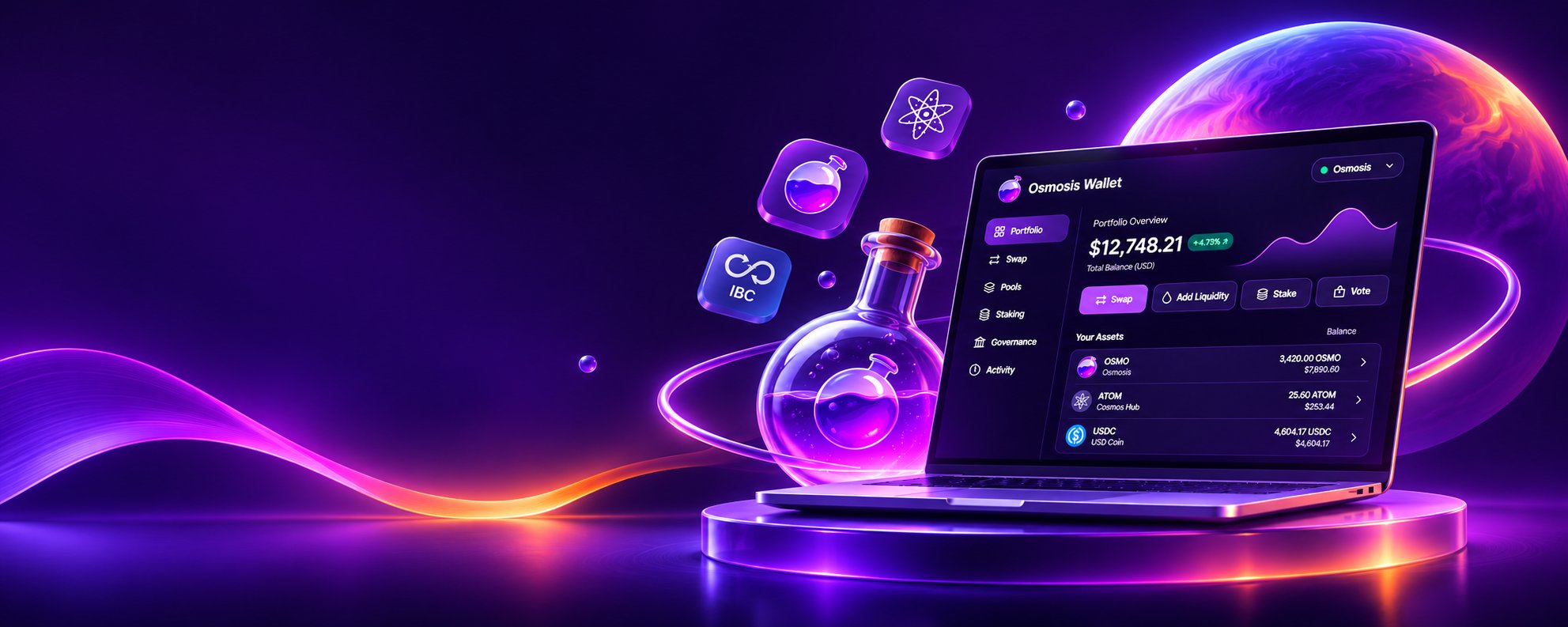
Windows, macOS or Linux. A focused desktop perspective on the Osmosis ecosystem.
A focused workspace for your Windows desktop.
A clearer interchain perspective on your Mac.

Your desktop. Your environment. Clear context.
An asset list is more useful when it tells the whole story. See identity, origin and network context together—and know what to look for before you approve a transaction.
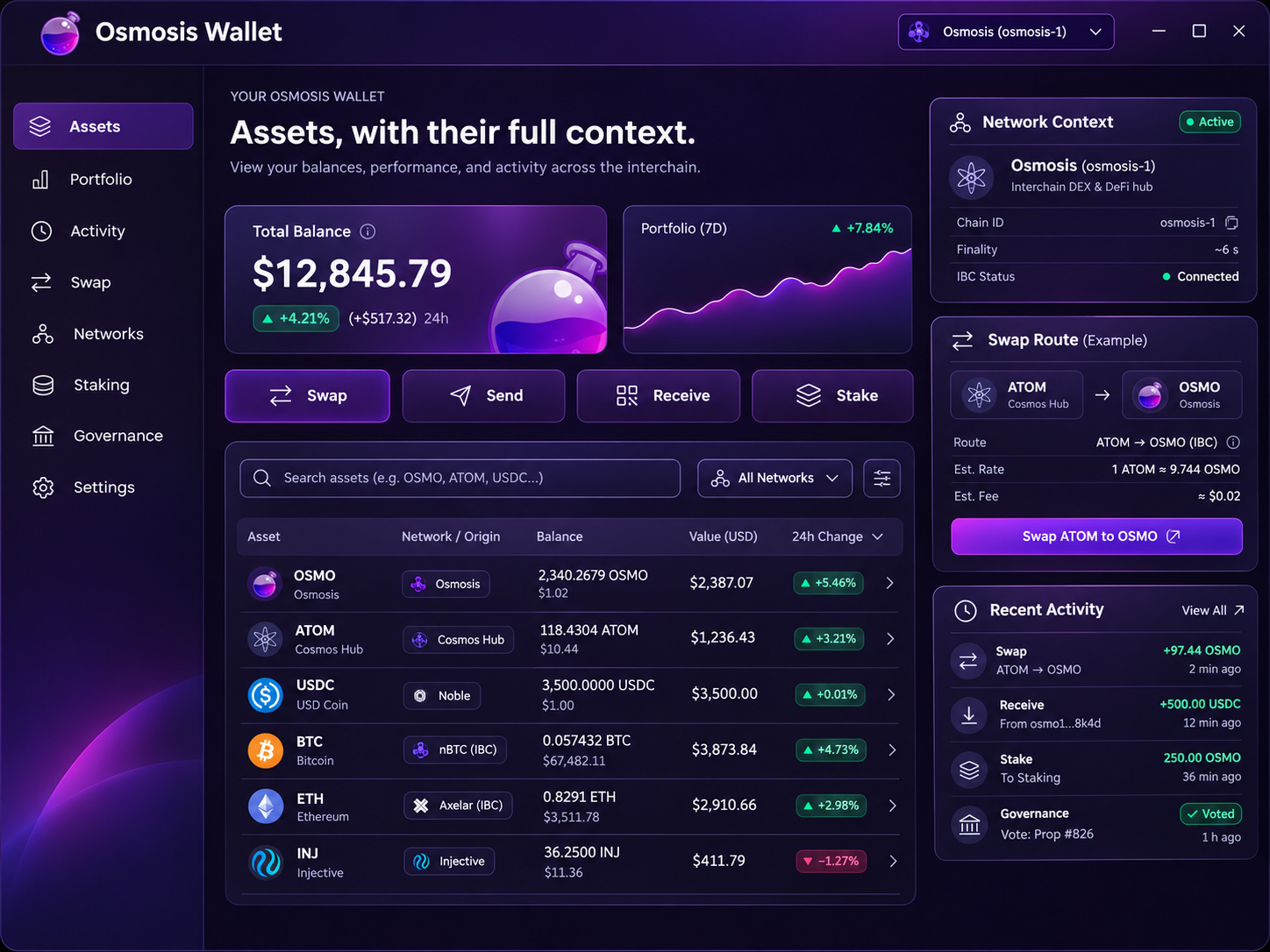
Bring asset identity, network context and transaction review into one reading flow. Explore each view to understand how a decentralized wallet workflow fits together.
Cosmos is an ecosystem of sovereign chains. IBC moves tokens between them. Osmosis, identified as osmosis-1, is one destination—not a name for every network.
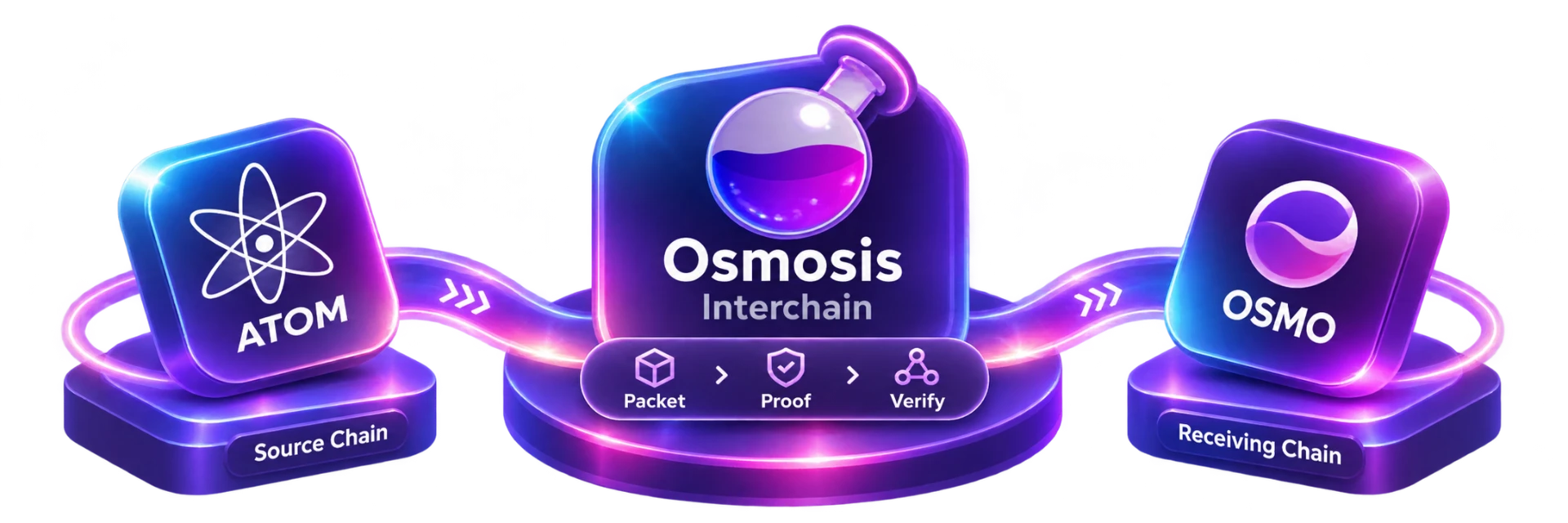
Illustrative protocol concept · Not a live transaction or a guarantee of route availability.
ATOM is native to Cosmos Hub. The source chain commits an IBC transfer packet for the receiving chain.
Original denominationRelayers transport packets and proofs. Light clients verify the relevant chain state; check the channel and denomination trace.
IBC protocol conceptOsmosis receives transferred ATOM as an IBC representation, not native OSMO. Its denomination records the transfer trace; origin and path provenance matter.
ibc/<HASH> · trace-dependentA ticker is not a transfer history. An IBC denomination carries channel and origin context; bridge provenance matters.
Understand IBCOsmosis uses automated markets and routing that can connect several pools. Explore how a route links liquidity and shapes the resulting exchange.
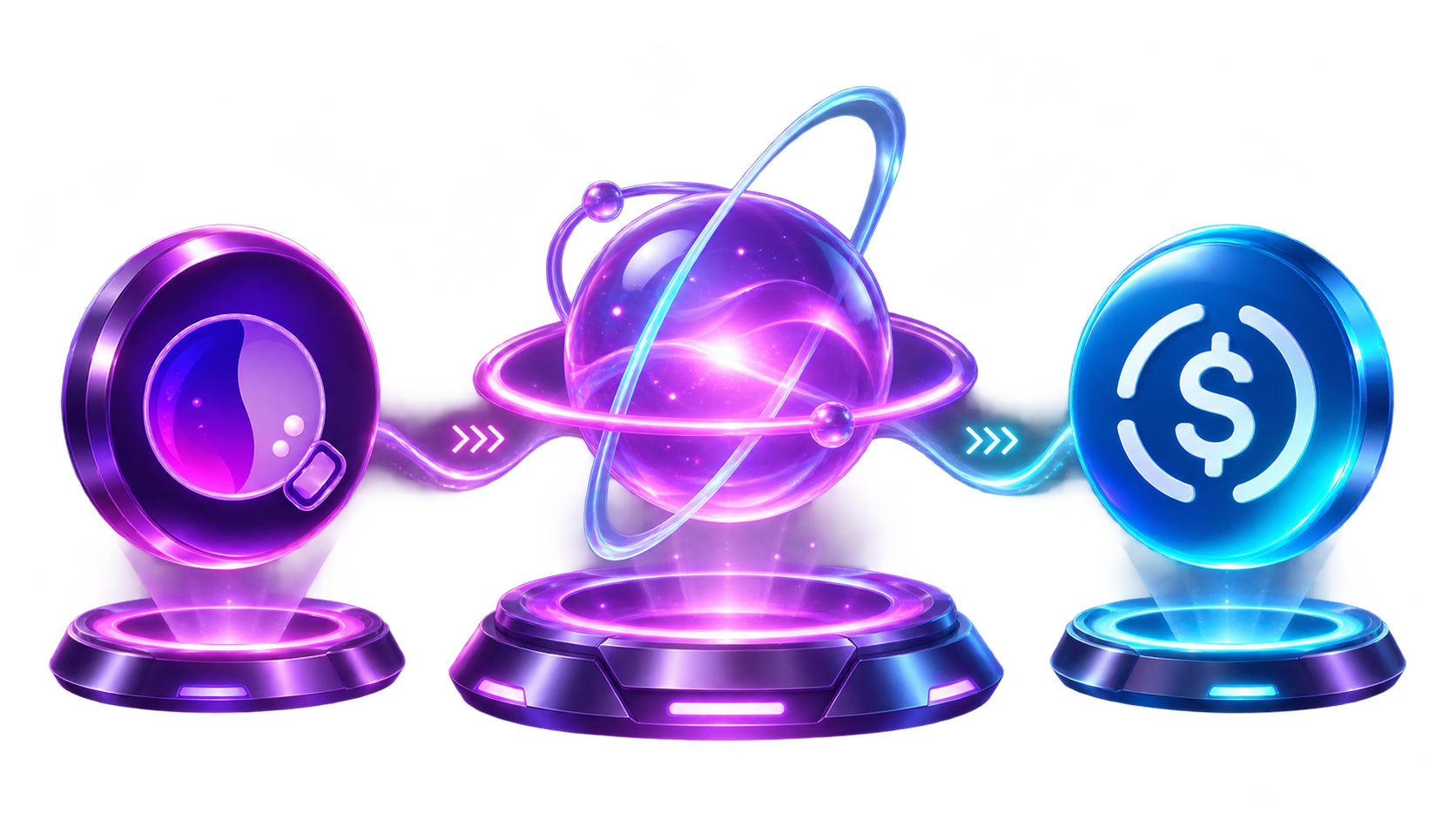
A trade moves the exchange rate available in a pool. The larger the order relative to available liquidity, the further the execution price can shift from the starting rate.
The executed outcome may differ from the expected one as conditions change before processing. A slippage tolerance sets the limit you are willing to accept; beyond it, the trade should not complete.
Pool spread fees paid to liquidity providers and any applicable protocol taker fees are separate costs, each with route-specific rules.
Processing a transaction on the network has its own cost, paid in a fee asset. Fee abstraction applies only to eligible tokens, so check which asset will cover gas.
Full-range positions and concentrated price ranges make different tradeoffs. LPs may earn fees, but relative price changes can leave a position worth less than holding the original assets.
Understand liquidity and risk
Liquidity spans a broader price domain; capital is not focused on one selected interval.
A chosen interval focuses capital between a lower and upper price boundary. While the current price is in range, liquidity can participate in trades and may earn fees.
Leaving the range changes fee participation and the asset composition of a position. Liquidity is no longer active for trades while price remains outside the interval, and composition can shift to one asset.
Relative price changes can leave a position worth less than holding the original assets. This is impermanent loss; earned fees may not offset it. A selected range is not protection against loss.
Native tokens, IBC denominations and bridged representations share a market ecosystem—not one identical security model.
Explore assets & networksNative to OsmosisOSMO is the network’s native asset.
Connected through IBCOrigin and channel identify the receiving denomination.
Representation mattersBTC, ETH, SOL and USDC depend on transfer route, issuer and denomination.
 OSMONative · Osmosis
 ATOMCosmos Hub · IBC
 USDCIssuer & route dependent
 ETHEthereum · represented
 BTCBitcoin · represented
 TIACelestia · IBC
 INJInjective · IBC
 AKTAkash Network · IBC
 SCRTSecret Network · IBC
 AXLAxelar Network · IBC
 STRDStride · IBC
 SOLSolana · represented
Explore asset identities across the Osmosis ecosystem: native tokens, IBC transfers and bridged representations, each with its own origin and transfer path.
OSMO connects staking, governance and transaction costs. Delegation helps secure the chain, but brings validator commission, an unbonding period and slashing risk.
Separate services. Different financial concepts. Get to know the distinction before considering the risk.
Leveraged market exposure brings margin and liquidation risk.
Derivative market exposure, rather than an ordinary spot purchase.
Explore Levana context
Borrowing against collateral means monitoring obligations and liquidation conditions.
Collateral-backed borrowing with interest and repayment obligations.
Explore Mars context
A derivative token brings its own redemption, validator and liquidity assumptions.
A transferable representation of a staked position, not the original asset.
Explore Stride contextDiscover the protocols, tools and communities around Osmosis.

Osmosis protocol code and governance mechanisms are publicly documented. Explore network activity, understand transaction context and follow community proposals through the onchain governance process.
Compare the full address using an independent source.
An address or ticker alone does not identify the receiving chain.
Check native, IBC and bridged representations separately.
Review action, permissions, gas and other costs.
Never enter recovery secrets into this site or support chat.
Verify distribution; protocol and bridge risks remain.
From setup steps to transaction safety, asset identification and network troubleshooting—our local library keeps the important context close.